Factors that impact Honeybees and their ecosystems
ByHoneybees, just like every other species have factors both ecologically and human made that affect them and their well beings. Issues like pests, genetics, and pesticide exposure are an example of some of these factors.
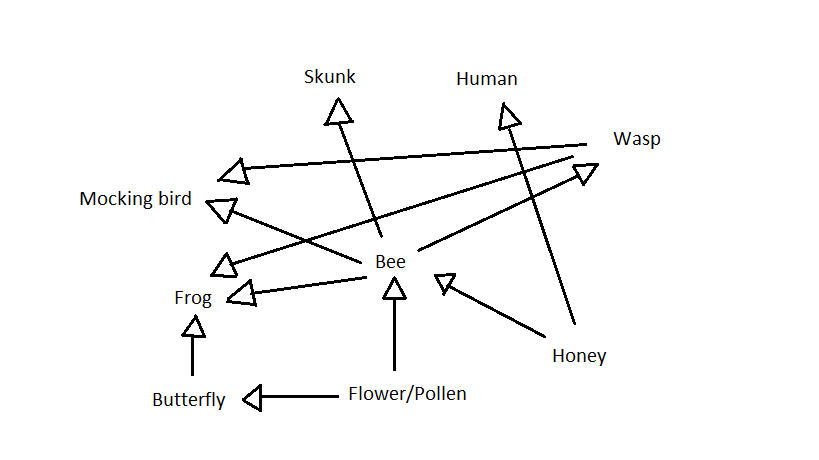
The food web shown above is found in the habitat of Honeybees-tropical climates with forested areas. There are many places where food webs such as this one can be found here in Ontario, most can be found at summertime in our back yards. This food web shows the complexity of honeybees, as well as the need for them. A few explanations of a few animals in the food web are as followed: Skunk- Land animal that sprays to defend itself from predators, Mockingbird- A gray and white bird, Butterfly- A flying, colourful insect.
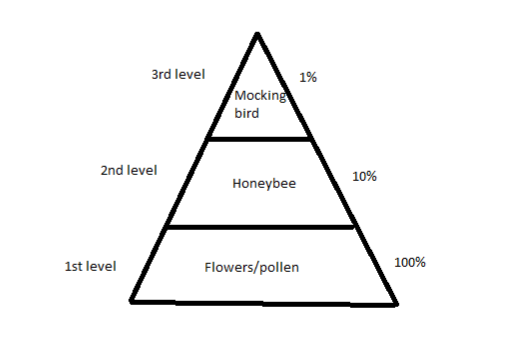
In the drawing shown above there is a pyramid of energy transfer, showing different species labeled on it. I chose for the plant flower/pollen to be at the first trophic level because it is a producer therefore having the most energy. I then chose the Honeybee because it it’s a primary consumer which eats the producer, transferring less energy. At the very top I chose the mockingbird because it eats the honeybee, taking in the least amount of energy than when the pyramid first started.
Human-caused factors:
Humans have significant impacts when it comes to harming wildlife, and even if it is unintentional- honeybees are no exception. A study from the United States Environmental Protection Agency said that before they can understand how bees are being affected, they first must find out how these pesticides are reaching bees. They ultimately discovered that direct spray of pesticides on plants are one of the main methods of the harm in bees, and not only are the bees who collect and eat the nectar affected, but so are the flowers and plants that have been sprayed- even if it was unintentional and meaning to spray weeds instead.
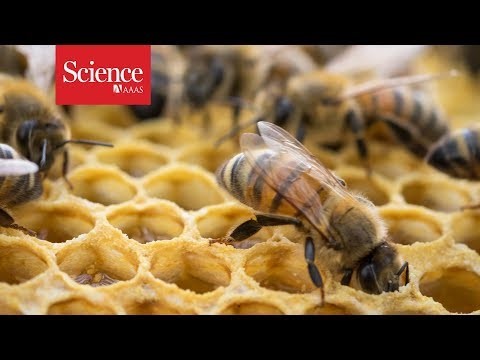
So how are honeybees affected by pesticides? According to the video, “Pesticides found in honey around the world” by Science Magazine pesticide use can cause things like growth disorders, limiting life span, reduced foraging efficiency, and harm to respiratory and reproduction systems in honeybees -just to name a few. Science Magazine also found that 75 percent of honey samples that they tested around the world were also contaminated with pesticides, which really-makes sense.
Science Magazine video: Pesticides found in honey around the world – YouTube
As we can see from the previously shown food web, everything is connected and if something changes in that system, things could go terribly wrong. For example, looking at the food web on this post, if the flowers die from being over-sprayed with pesticide, that cuts off food for the honeybees because they won’t have any nectar to make honey and if there’s no pollen or flowers then the butterflies will also suffer. If there’s no food for the bees, they will eventually die cutting off a food source for the skunks, mockingbirds, wasps, and frogs. It is important to take care of the producers, as well as the organisms in the rest of the food webs so that there’s balance and sustainability within ecosystems.

Sources:
Toxic impact of pesticides on bees has doubled, study shows | Pesticides | The Guardian
Understanding How Pesticide Exposure Affects Honey Bee Colonies | US EPA
What Animals Eat Bees? 8 Examples with Pictures! – Animal Quarters